
Are Almonds Good for GERD: 6 Essential Facts
Are almonds good for GERD or acid reflux? Learn 6 essential facts on fat, portions, raw vs roasted almonds, almond butter, and heartburn risk.
Introduction

Are almonds good for GERD? They can be, in a modest portion, if you tolerate them. Almonds are a nutrient-dense tree nut with fiber, plant protein, and mostly unsaturated fat. They are still high in fat, though, and high-fat foods are commonly linked to GERD symptoms. Almonds aren't a treatment. A large handful may be less suitable for some people because of the fat, and oil-roasted or flavored almonds, or a large serving of almond butter, may bother people sensitive to those extras.
A small handful of plain almonds may be a reasonable snack if you tolerate them. Start with a modest portion of raw or dry-roasted unsalted almonds. If you have nighttime reflux, avoid eating within 3 hours of lying down. If you have a tree nut allergy, skip almonds entirely.
You'll find six facts on nutrition, alkaline-food claims, roasting, portions, heartburn risk, and how to test this snack.
Fact Set 1: Nutrition vs. Alkaline-Food Claims
Almonds offer useful nutrition, but that does not mean they treat acid reflux.
Fact 1: Almonds Are a Nutrient-Dense Tree Nut, Not a GERD Treatment
Do almonds help with acid reflux? No established clinical evidence shows that eating almonds treats GERD or reliably relieves acid reflux symptoms, and they are not shown to neutralize stomach acid. They are a tree nut, and a common 1-ounce serving (about 28 grams, or about 23 almonds) of raw almonds has about 164 calories, 14 grams of fat, 6 grams of protein, and 3.5 grams of fiber, according to USDA FoodData Central. Per 100 grams, raw almonds provide about 579 calories, 49.9 grams of fat, 12.5 grams of fiber, and 21.2 grams of protein. They also supply magnesium and vitamin E, which is nutritional context, not evidence of heartburn relief.
The NIDDK does not name almonds. It focuses on foods commonly linked to GERD symptoms, including high-fat foods, citrus, chocolate, mint, caffeine, alcohol, and spicy foods.
Cleveland Clinic also doesn't list almonds as a GERD-friendly snack. So whether almonds fit a reflux-conscious eating pattern depends on the portion, the preparation, and your own tolerance, not a guarantee.
For a lower-fat, high-fiber breakfast option, see Is Oatmeal Good for Acid Reflux.
Fact 2: "Alkaline" Claims Don't Make Almonds a Reflux Remedy
Johns Hopkins Medicine lists nuts among "alkaline foods" that "can help offset strong stomach acid." It does not name almonds specifically, so treat this as a general nuts pattern rather than an almonds recommendation, and it does not establish that almonds relieve GERD.
Food pH also cannot establish whether a snack will trigger GERD symptoms. An archived FDA list of approximate food pH values does not include a row for almonds, so we cannot cite a specific FDA pH for this nut. Even if a food is less acidic than citrus, a high-fat serving can still be a problem for some people.
Are almonds good for acid reflux because they contain healthy fats? Most of the fat in almonds is unsaturated, which is a useful distinction for general nutrition. That does not automatically make almonds suitable for GERD. The total fat may still matter, and the NIDDK does not distinguish fat types when it lists high-fat foods among common triggers. Johns Hopkins also includes high-fat foods among common triggers. A modest handful of plain almonds can still be reasonable if you tolerate it; a large bowl, especially of oil-roasted almonds, is a different snack.
| Food (per 100 g) | Calories | Fat | Fiber | Sodium |
|---|---|---|---|---|
| Almonds, raw | About 579 | About 49.9 g | About 12.5 g | About 1 mg |
| Almonds, dry roasted, without salt | About 598 | About 52.5 g | About 10.9 g | About 3 mg |
| Almonds, oil roasted, without salt | About 607 | About 55.2 g | About 10.5 g | About 1 mg |
Table: Approximate USDA FoodData Central values for raw almonds (FDC 170567), dry-roasted almonds without salt (FDC 170158), and oil-roasted almonds without salt (FDC 170159). Per 100 grams is for comparison, not a typical serving size. A common 1-ounce serving is about 28 grams.
Fact Set 2: Raw vs. Roasted Almonds, Almond Butter, and Portions
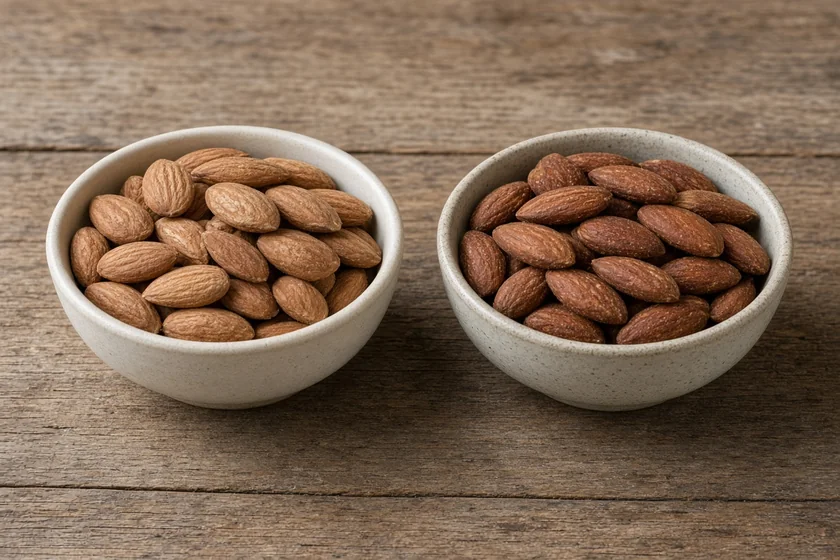
Do raw almonds help heartburn? There isn't evidence that raw almonds are automatically better than roasted ones. The extras and the portion often matter more.
Fact 3: Raw Almonds Aren't Automatically Better; Roasted and Flavored Versions Can Change the Picture
Raw and dry-roasted unsalted almonds are fairly close in calories and fat. The USDA values listed here show slightly higher calories and fat in oil-roasted almonds, because oil is added during roasting; exact values depend on the product. That difference may not matter in a small handful, but it can add up in a large serving.
Salted almonds raise a different issue. The NIDDK does not list salt as a standalone GERD trigger. Johns Hopkins groups high-salt foods with high-fat and spicy foods as items some people may need to limit. If salty foods worsen your symptoms, unsalted almonds are a better place to start.
Flavored varieties can change the picture more than roasting itself. Honey-roasted, chili, barbecue, and chocolate-covered almonds add sugar, spice, or chocolate. NIDDK and Johns Hopkins both include spicy foods and chocolate among foods commonly linked to GERD symptoms. If you already react to those, plain almonds are a better place to start. Read the ingredient list instead of going by the flavor name.
Is almond butter good for acid reflux? It can be, in a thin smear, if you tolerate almonds. Almond butter is a concentrated form of the same nut. USDA data for plain, unsalted almond butter (FDC 168588) list about 614 calories and 55.5 grams of fat per 100 grams. One tablespoon (about 16 grams) has about 98 calories and 8.9 grams of fat. A heaping spoon of almond butter, especially close to bedtime, provides more fat than a thin smear on toast or oatmeal. Our oatmeal guide also suggests starting with a thin smear. Prefer to drink your almonds? See Does Almond Milk Help Acid Reflux.
Fact 4: There's No Official Almond Count for GERD
How many almonds should I eat for acid reflux? No official GERD serving size exists for almonds. A common 1-ounce serving is about 23 almonds, but that is a standard nutrition portion, not a medical dose.
If you want to test this snack, start smaller than a full ounce, such as about 10 almonds or a small handful. This is only an illustrative place to start, not an established GERD serving. Don't treat a large bowl as a single snack. Because almonds are calorie- and fat-dense, it is easy to eat more than you planned if you snack straight from a big bag.
Timing still matters. Johns Hopkins advises avoiding late-night dinners and bedtime snacks, and it recommends small, frequent meals instead of heavy ones. The NIDDK says eating at least 3 hours before lying down may improve nighttime symptoms. The American College of Gastroenterology (ACG) similarly suggests avoiding meals within 2 to 3 hours of bedtime.
Fact Set 3: When Almonds Can Cause Heartburn, and How to Test Them
Portion size and timing can still make a difference.
Fact 5: Almonds Can Still Cause Heartburn for Some People
Can almonds cause heartburn? Yes, for some people. Almonds aren't a common item on clinical trigger lists by name, but they are high in fat, and high-fat foods are commonly linked to GERD symptoms. A large handful, oil-roasted almonds, a flavored mix, or a generous scoop of almond butter can trigger heartburn in someone who otherwise tolerates a few plain almonds.
A large handful, or eating almonds shortly before lying down, can also make symptoms more likely. If even a small, plain, well-timed portion bothers you, almonds may not agree with you.
Fact 6: Start Small, Watch the Clock, and Take Allergies Seriously
The 2022 ACG clinical guideline conditionally suggests avoiding foods that trigger your GERD symptoms, a recommendation based on low-quality evidence. Individual responses vary, so a food diary can help you see whether the portion, roasting style, flavoring, or timing is the issue.
Almonds count as a tree nut, and the U.S. Food and Drug Administration includes tree nuts among the major food allergens. If you have a tree nut allergy, skip almonds and almond butter, and follow your doctor's advice. Hives or swelling can signal an allergic reaction. Trouble breathing, or swelling of the tongue or throat, needs emergency care. These symptoms are not the same as heartburn.
For a lower-fat snack to compare, see Is Popcorn Good for Acid Reflux, Are Pretzels Good for Acid Reflux, and Is Hummus Good for GERD. Popcorn and pretzels are typically lower in fat than a handful of almonds; hummus can be a middle ground, depending on the recipe.
When to See a Doctor

Johns Hopkins Medicine advises seeing a doctor if you have heartburn two or more times a week and changes to your diet or eating pattern haven't helped. MedlinePlus notes that GERD can also cause a dry cough, hoarseness, or trouble swallowing.
The NIDDK also advises seeing a doctor for symptoms that could be related to GERD complications or other serious health problems:
- Problems swallowing or pain while swallowing
- Persistent vomiting or loss of appetite
- Blood in the vomit, or vomit that looks like coffee grounds
- Blood in the stool, or stool that looks black and tarry
- Weight loss you cannot explain
Emergency: Call 911 (or your local emergency number) right away if you have chest pain, especially with shortness of breath or pain in your jaw or arm. The American Heart Association notes that heartburn and heart problems can feel alike, so never assume chest pain is just reflux.
Conclusion
So, are almonds good for GERD? A small handful of plain almonds can be a suitable snack if you tolerate them, but they aren't an established treatment. They are nutrient-dense, and some alkaline-food lists include nuts, but almonds are still high in fat. Raw almonds aren't automatically better than roasted ones; flavored or oil-roasted versions can change the picture, and almond butter is a concentrated serving of the same fat. A modest, well-timed portion and a food diary may help you determine whether almonds are linked to your reflux symptoms.
For a whole-grain breakfast option, see Is Oatmeal Good for Acid Reflux. For other snack ideas, see Is Popcorn Good for Acid Reflux, Are Pretzels Good for Acid Reflux, and Is Hummus Good for GERD. For meal timing and sleep position, see our GERD relief guide.
Do plain, roasted, or flavored almonds affect your reflux symptoms differently? Share your experience in the comments.
Sources
- Eating, Diet, and Nutrition for GER and GERD (NIDDK)
- Symptoms and Causes of GER and GERD (NIDDK)
- GERD Diet: Foods That Help with Acid Reflux (Johns Hopkins Medicine)
- GERD Diet: Foods To Eat and Avoid (Cleveland Clinic)
- ACG Clinical Guideline for the Diagnosis and Management of Gastroesophageal Reflux Disease (American Journal of Gastroenterology, 2022)
- Approximate pH of Foods and Food Products (U.S. FDA, archived)
- USDA FoodData Central nutrient records used in this article: almonds, raw 170567, almonds, dry roasted, without salt 170158, almonds, oil roasted, without salt 170159, almond butter, plain, without salt 168588
- Food Allergies (U.S. Food and Drug Administration)
- Gastroesophageal Reflux Disease (MedlinePlus)
- Heartburn or Heart Attack? (American Heart Association)
FAQ
1. Are almonds good for GERD?
They can be, in a modest portion, if you tolerate them, but they aren't a GERD treatment. Start with a small handful of plain almonds, well before bed. If you have a tree nut allergy, skip them.
2. Do almonds help with acid reflux?
No established clinical evidence shows that eating almonds treats acid reflux or reliably relieves symptoms. Johns Hopkins lists nuts among alkaline foods, but it does not name almonds specifically, and food pH cannot predict symptoms.
3. How many almonds should I eat for acid reflux?
There is no official GERD serving size. A common 1-ounce serving is about 23 almonds, but that is a nutrition portion, not a medical dose. An illustrative place to start is about 10 almonds, or a small handful, with a food diary to track how you feel.
4. Are roasted almonds bad for GERD?
Not automatically. Dry-roasted unsalted almonds are close to raw almonds in calories and fat. Oil-roasted almonds are a little higher in fat, and salted or flavored varieties, such as chili or chocolate-covered almonds, can be more of a problem if spicy foods or chocolate already trigger your symptoms.
5. Can almonds cause heartburn?
Yes, for some people, especially in a large, high-fat serving, or when the almonds are oil-roasted, heavily flavored, or eaten too close to bedtime. Almond butter is a concentrated form of the same fat, so start with a thin smear rather than a heaping spoon.
About the author

Health Researcher and Writer
Haider Nadeem is a health researcher and the writer behind Healthy Eats Guide. He writes about health problems he faces or sees people around him face, and turns careful research into practical guides. Articles are researched and drafted with AI assistance, then fact-checked and edited by Haider using cited sources such as USDA, NIH, and peer-reviewed research.
Related blogs

GERD Relief: 7 Proven Tips to Manage Flare-Ups
GERD relief that works: 7 proven tips covering meal timing, trigger foods, weight, sleep position, medicines and surgery, plus warning signs to act on.
9 min read
Is Hummus Good for GERD: 6 Evidence-Based Facts
Is hummus good for GERD? Learn how chickpeas, tahini, garlic, lemon, and serving sizes may affect acid reflux, plus tips for choosing a simpler hummus.
12 min read
Are Blueberries Good for GERD: 5 Evidence-Based Facts
Are blueberries good for GERD? See how their pH compares with other fruits, plus fiber, frozen vs. dried berries, oatmeal pairings, and portion tips.
12 min read
Newsletter
Get practical nutrition guides in your inbox
Clear food-by-food advice and diet tips for everyday eating — no spam, unsubscribe anytime.