
Is Mango Good for Acid Reflux: 5 Essential Facts
Is mango good for acid reflux? Learn how ripe mango's pH compares with other fruits, plus how ripeness, portions, dried mango, juice, and timing may affect GERD.
By Healthy Eats Guide Team
Published
12 min read
Introduction

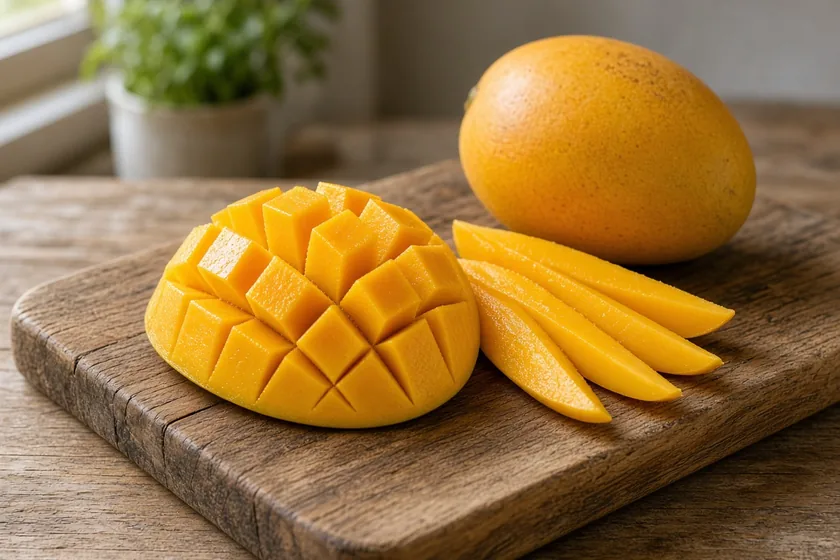
Is mango good for acid reflux? It can fit into a reflux-friendly diet for some people because fresh mango is low in fat and offers some fiber. Ripe mango has a lower pH than bananas or melons. Still, a fruit's acidity alone can't tell you whether it will trigger your reflux. Tolerance varies from person to person, and mango doesn't treat reflux.
Picture a bowl of sweet mango cubes after lunch. If certain fruits trigger heartburn, you may wonder whether it's worth the risk.
Mango may be okay for acid reflux if you tolerate it, especially fresh, ripe mango in a modest portion eaten well before bed. Its measured acidity overlaps with some oranges, though, so people who react to acidic fruit should be more careful.
This guide covers five facts: mango's acidity, ripeness, portion size, dried mango and juice, and the best time to eat mango with acid reflux.
Fact Set 1: How Acidic Is Mango, Really?
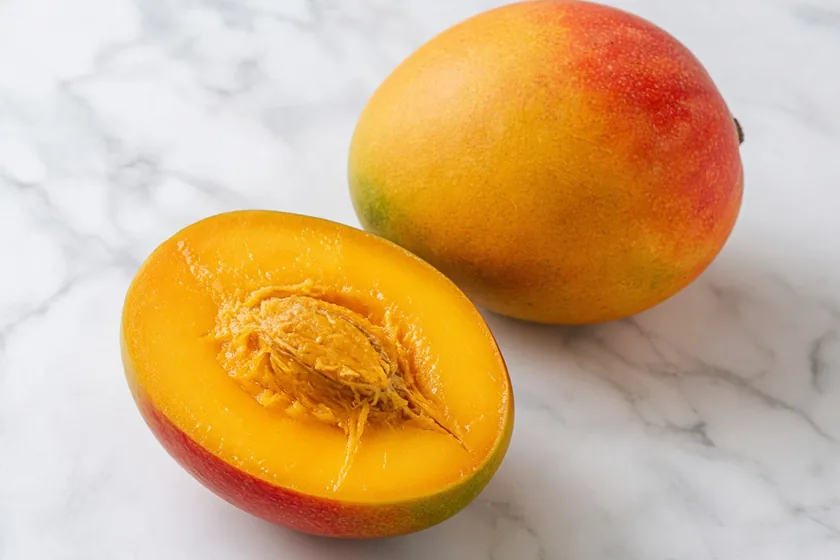
When people ask whether mangoes are good for acid reflux, acidity is usually the first concern.
Fact 1: Ripe Mango Is More Acidic Than Bananas or Melons
Is ripe mango acidic? Yes. An archived FDA reference list of approximate food pH values puts ripe mangoes at about 3.40 to 4.80. That's historical lab data, and actual values vary, but it's a useful benchmark.
| Food (FDA approximate pH list) | Approx. pH | How it compares with ripe mango |
|---|---|---|
| Lemon juice | 2.00 to 2.60 | Much more acidic |
| Pineapple | 3.20 to 4.00 | Similar or slightly more acidic |
| Oranges, Florida | 3.69 to 4.34 | Overlapping range |
| Mangoes, ripe | 3.40 to 4.80 | Reference |
| Bananas | 4.50 to 5.20 | Less acidic |
| Watermelon | 5.18 to 5.60 | Less acidic |
| Cantaloupe | 6.13 to 6.58 | Much less acidic |
Table: Approximate pH ranges from the FDA's archived list of food pH values. Lower numbers mean more acidic. Actual values vary with variety, ripeness, and growing conditions.
On fruit pH alone, mango sits closer to oranges than to bananas or melons. pH is a logarithmic scale, so a one-point drop marks roughly a tenfold rise in hydrogen-ion activity. pH reflects acid strength, while titratable acidity measures total acid content. Neither number predicts reflux symptoms.
The NIDDK lists acidic foods, such as citrus fruits and tomatoes, among the foods most often linked to GERD symptoms. Mango isn't named on that list. Some people with reflux eat it without trouble, while others react after a few bites.
Fact 2: Ripeness Changes Mango's Acids, Sugars, and Enzymes
In a 2014 study of Ashwina hybrid mangoes during storage, titratable acidity, vitamin C, and starch were higher in unripe fruit and gradually decreased as the mangoes ripened. Total sugars rose at the same time, which is why ripe mango tastes sweeter. That was one variety in storage, and it measured the fruit, not reflux symptoms.
Reference tables don't always agree on the pH of green mangoes. Green mango also shows up in sour pickles and chutneys that often include chili or vinegar, and spicy foods are on the NIDDK trigger list. For most people testing their tolerance, soft, fully ripe mango on its own is the simpler starting point.
What about digestive enzymes? Mangoes contain amylase, an enzyme that helps break starch into sugar as the fruit ripens. The same 2014 study found amylase activity rose sharply in the first days of ripening at room temperature. There's no good evidence that eating these enzymes eases reflux.
Fact Set 2: Fiber, Fat, and Portion Size
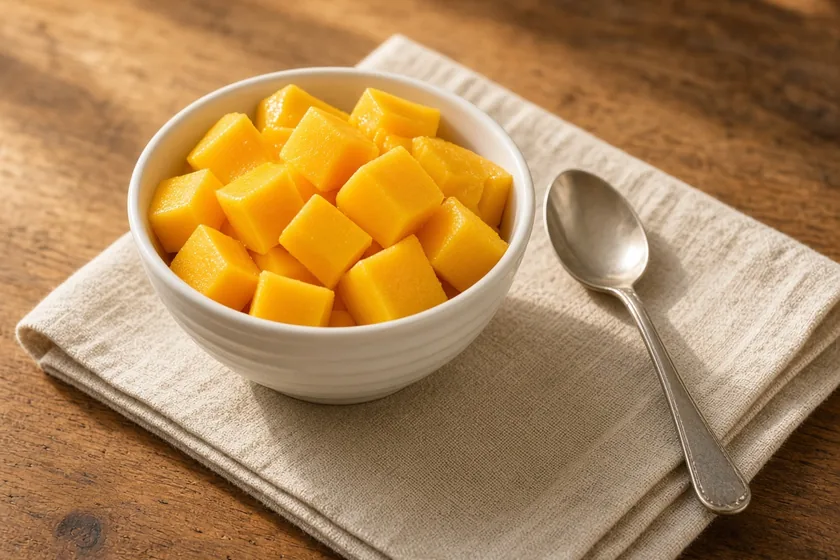
Fat, fiber, and how much you eat at once also shape how a food sits in your stomach.
Fact 3: Mango Is Low in Fat, but Large Portions Can Still Trigger Symptoms
Johns Hopkins Medicine names fried food, fast food, pizza, and fatty meats as some of the worst heartburn culprits. According to USDA FoodData Central, one cup of mango pieces (165 grams) has about 99 calories, about 0.6 grams of fat, and about 2.6 grams of fiber.
That fat content is far below many fried or high-fat snacks, though low fat alone doesn't guarantee mango will sit well. Johns Hopkins notes that fiber-rich foods help you feel full, so you're less likely to overeat. In a small 2018 pilot study, adults with chronic constipation who ate 300 grams of mango daily for four weeks improved more than those given the same amount of fiber. That study didn't look at GERD.
Can mango cause heartburn? It can for some people. A few reasons stand out:
- Acidity. Ripe mango has a lower pH than bananas or melons, which may matter if acidic foods bother you.
- Volume. A large mango is easy to finish in one sitting. Johns Hopkins suggests small, frequent meals instead of big ones.
- Fructose and bloating. Monash University lists mangoes among fruits high in excess fructose. People with IBS or fructose malabsorption may bloat after a big serving, but that doesn't show mango directly worsens GERD.
Is mango okay for acid reflux in small amounts? It may be, if you tolerate fruit well. Starting with about half a cup is a practical way to test your tolerance, not an official GERD serving. Try it on a calm day, note how you feel over the next few hours, and adjust from there.
Fact Set 3: Dried Mango, Mango Juice, and Timing
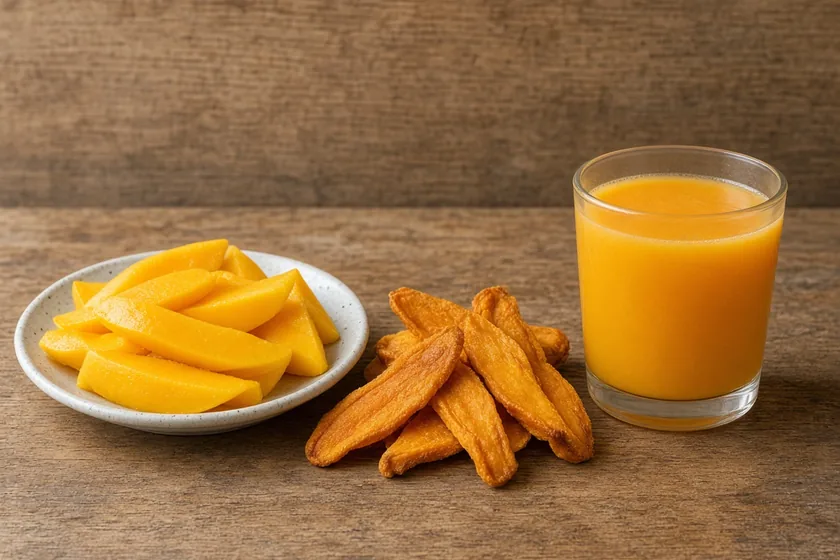
The form of mango and when you eat it also matter.
Fact 4: Dried Mango and Mango Juice Aren't the Same as Fresh Fruit
Is dried mango bad for acid reflux? Not necessarily, but it's much easier to overeat. Drying removes most of the water, concentrating sugar and calories into small pieces, and many brands add sugar. Is mango juice good for GERD? There's no evidence that it soothes reflux, and it has far less fiber than the whole fruit.
The table compares 100 grams of each form using USDA data.
| Mango form (per 100 g) | Calories | Water | Fat | Fiber | Total sugars |
|---|---|---|---|---|---|
| Fresh mango, raw | About 60 | About 83 g | About 0.4 g | About 1.6 g | About 13.7 g |
| Dried mango, sweetened | About 319 | About 17 g | About 1.2 g | About 2.4 g | About 66 g |
| Mango nectar, canned | About 51 | About 87 g | Less than 0.1 g | About 0.3 g | About 12.4 g |
Table: Approximate values from USDA FoodData Central records for raw mango (FDC 169910), sweetened dried mango (FDC 169091), and canned mango nectar (FDC 167785). Brands and recipes vary, so check the label.
- Dried mango packs about five times the calories of fresh mango by weight, and Monash lists dried fruit as high in excess fructose. Unsweetened versions avoid added sugar, but the fruit's natural sugars are still concentrated, so keep portions modest.
- Mango nectar is low in fiber. One cup (251 grams) has about 128 calories and about 31 grams of sugar, and drinking it quickly adds a lot of liquid at once.
- Mango smoothies and lassi depend on the add-ins. Johns Hopkins notes that the fat in full-fat dairy can aggravate reflux, and orange juice adds citrus.
The Dietary Guidelines for Americans, 2025-2030 encourage eating fruits in their whole form. They say dried fruits with no or very limited added sugars can be good options, and that you should consume 100% fruit juice in limited portions or dilute it with water. Some mango drinks also contain lime or lemon juice, so read the label.
Fact 5: Timing and Pairings Matter More Than You Might Think
What's the best time to eat mango with acid reflux? There's no proven best time of day. The NIDDK says eating meals at least 3 hours before lying down may improve nighttime symptoms, and the ACG clinical guideline suggests avoiding meals within 2 to 3 hours of bedtime, a conditional recommendation based on low-quality evidence.
The same guideline suggests avoiding personal "trigger foods," again with low-level evidence. So mango is a personal call, not a universal yes or no. Try these habits:
- Leave time before bed. Finish mango at least 3 hours before lying down.
- Pair it with foods you already tolerate. Mango with plain oatmeal or low-fat yogurt can make a balanced snack, if those foods don't trigger your symptoms. Our guide on yogurt and acid reflux explains which types tend to sit best.
- Skip the chili-lime topping. Citrus and spicy foods are both common GERD triggers, according to the NIDDK.
- Don't stack it on a heavy meal. A big bowl after a large dinner adds volume to a full stomach.
- Track your response. Note the amount, the ripeness, the time, and any symptoms.
When to See a Doctor

Some symptoms need a professional look. Johns Hopkins Medicine advises seeing a doctor if heartburn happens twice a week or more and adjusting what or how you eat hasn't helped. MedlinePlus notes that GERD can also cause a dry cough, a hoarse voice, or trouble swallowing.
Also see your doctor if heartburn keeps returning, wakes you at night, or doesn't improve with lifestyle changes or nonprescription medicine.
The NIDDK also lists symptoms that need prompt medical attention:
- Problems swallowing or pain while swallowing
- Persistent vomiting or loss of appetite
- Vomit that contains blood or looks like coffee grounds
- Stool that contains blood or looks black and tarry
- Unexplained weight loss
Diet changes work best alongside medical care, not in place of it.
Emergency: Call 911 (or your local emergency number) right away if you have chest pain, especially with shortness of breath or pain in your jaw or arm. Heart problems can feel like heartburn, so never assume chest pain is just reflux.
Conclusion
So, is mango good for acid reflux? Ripe mango has a lower pH than bananas or melons, with a range that overlaps some oranges. Ripening lowered total acid in one study. It's low in fat with some fiber, but large portions can still cause trouble. Dried mango and mango juice behave differently from the fresh fruit. And timing and pairings matter.
Is mango good for GERD, then? It may be for many people in modest amounts, but your response matters more than the fruit's pH. Start with a small serving of fresh, ripe mango well before bedtime, skip spicy or citrus toppings, and let your symptom patterns guide you. No single fruit treats reflux.
Want to compare other fruits? Our guide Are Bananas Good for Acid Reflux covers ripeness, portions, and smoothie add-ins, and Is Watermelon Good for Acid Reflux looks at a fruit that's far less acidic. For broader habits like meal timing and sleep position, see our guide to GERD relief. Guides on pineapple and blueberries are coming soon.
Does mango sit well with your reflux, or do you stick to bananas and melons? Share what works for you in the comments.
Sources
- Eating, Diet, and Nutrition for GER and GERD (NIDDK)
- Symptoms and Causes of GER and GERD (NIDDK)
- GERD Diet: Foods That Help with Acid Reflux (Johns Hopkins Medicine)
- ACG Clinical Guideline for the Diagnosis and Management of Gastroesophageal Reflux Disease (American Journal of Gastroenterology, 2022)
- Approximate pH of Foods and Food Products (U.S. FDA, archived)
- USDA FoodData Central nutrient records used in the table: mangos, raw 169910, mango, dried, sweetened 169091, mango nectar, canned 167785
- Changes in Biochemical Characteristics and Activities of Ripening Associated Enzymes in Mango Fruit (Biomed Research International, 2014)
- Polyphenol-rich Mango Ameliorate Functional Constipation Symptoms in Humans (Molecular Nutrition and Food Research, 2018)
- High and Low FODMAP Foods (Monash University FODMAP)
- Dietary Guidelines for Americans, 2025-2030 (USDA and HHS)
- Gastroesophageal Reflux Disease (MedlinePlus)
FAQ
Short answers to the mango and reflux questions readers ask most.
1. Is mango good for acid reflux?
It can be for people who tolerate it. Fresh mango is low in fat and has some fiber, but ripe mango has a lower pH than bananas or melons. Start with a small portion and watch how you feel.
2. Is ripe mango acidic?
Yes. The FDA's approximate pH list puts ripe mangoes at about 3.40 to 4.80, a range that overlaps some oranges. Total acid content tends to drop as mangoes ripen, but pH alone can't predict your symptoms.
3. Can mango cause heartburn?
It can for some people. A large portion or eating shortly before lying down may contribute to symptoms. Its acidity may matter if you're sensitive to acidic foods, but pH alone can't predict heartburn. Excess fructose can also cause bloating in sensitive people.
4. Is mango juice good for GERD?
There's no evidence that mango juice soothes GERD. It has much less fiber than whole mango, and a big glass adds a lot of liquid at once. If you choose to drink it, start with a modest amount and watch your symptoms.
5. Is dried mango bad for acid reflux?
Not necessarily, but it's easy to overeat. Sweetened dried mango has about 319 calories and 66 grams of sugar per 100 grams. Unsweetened versions skip added sugar, but natural sugars stay concentrated, so keep portions modest.
About the author
Healthy Eats Guide Team
Editorial Team
The Healthy Eats Guide editorial team researches and writes practical health and wellness content focused on clarity, sourcing, and everyday usefulness.
Related blogs
Is Watermelon Good for Acid Reflux: 5 Essential Facts
Is watermelon good for acid reflux? Learn how its acidity, water content, portion size, juice, and late-night timing may affect GERD, plus how other melons compare.
12 min read
Are Bananas Good for Acid Reflux: 6 Essential Facts
Are bananas good for acid reflux? See how ripeness, portion size, and smoothie add-ins shape bananas for GERD, and why a banana is a snack, not a treatment.
12 min read
Is Olive Oil Good for Acid Reflux: 6 Essential Facts
Is olive oil good for acid reflux? See how fat, EVOO, butter swaps, and frying may affect GERD, and why portion tolerance matters more than brand.
11 min read
Newsletter
Get practical health guides in your inbox
Occasional updates with clear nutrition, habits, and wellness reading — no spam, unsubscribe anytime.