
Is Green Tea Good for Acid Reflux: 6 Evidence-Based Facts
Is green tea good for acid reflux? Learn 6 evidence-based facts on caffeine, decaf green tea, herbal teas, coffee, timing, and how to test your tolerance.
Introduction

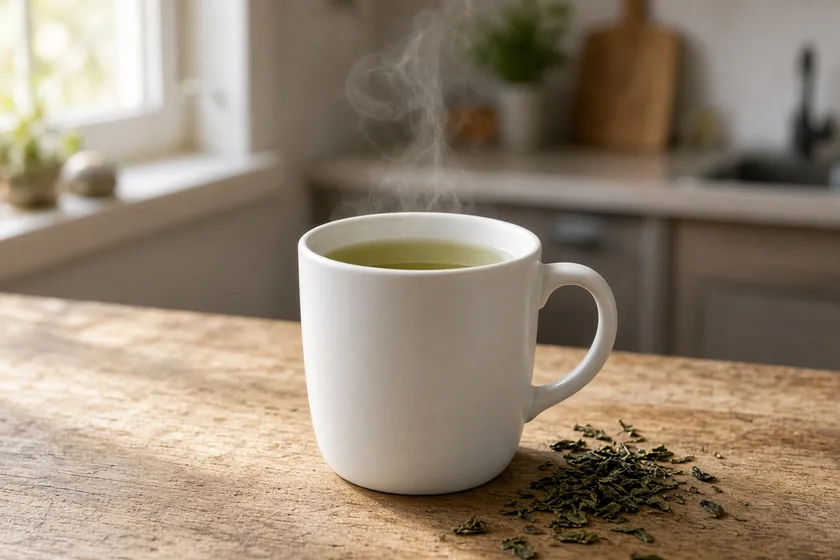
Is green tea good for acid reflux? It can be, for some people, in a modest amount, but it is not a treatment. Plain green tea has almost no calories or fat and usually less caffeine than coffee. It still contains caffeine, though, a common GERD trigger, and research on tea and reflux is mixed.
If you enjoy green tea, start with one weak or decaf cup with a meal, skip lemon or mint add-ins if they trigger your reflux, and avoid lying down within 3 hours of eating. If it brings on heartburn, a caffeine-free herbal tea such as chamomile may be a gentler swap.
Below are six facts on the research, caffeine, decaf and herbal teas, coffee, timing, and testing your tolerance.
Fact Set 1: What the Research Says About Green Tea and Reflux
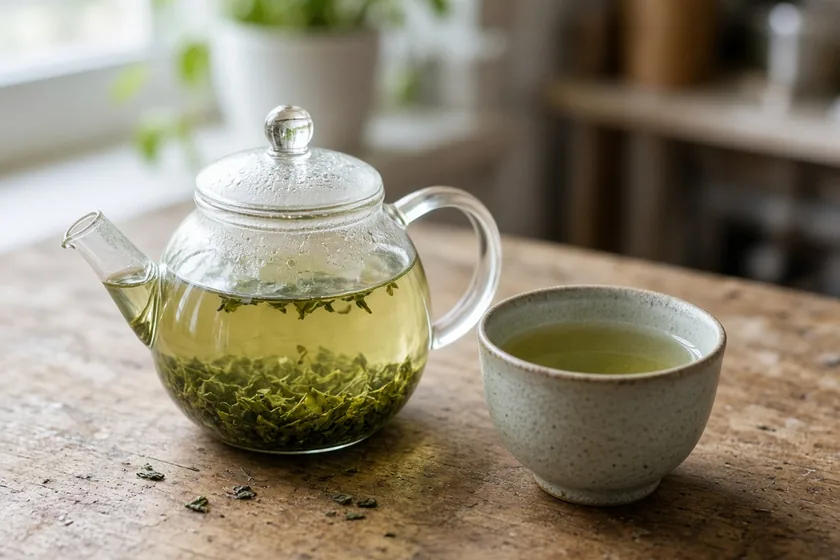
Green tea has a healthy reputation, but the reflux evidence is mixed.
Fact 1: Green Tea Isn't a GERD Treatment, and the Studies Are Mixed
Does green tea help with acid reflux? No clinical trial shows that drinking green tea treats GERD or reliably relieves heartburn. Green tea comes from the same plant as black tea, Camellia sinensis, and contains compounds called catechins. The National Center for Complementary and Integrative Health (NCCIH) says definite conclusions can't yet be reached on whether green tea helps with most of the uses it is promoted for. No study we found shows that catechins protect the esophagus or lower stomach acid.
Population studies don't agree:
- A 2026 Taiwanese study of 27,119 adults linked daily tea drinking to a lower GERD prevalence. The link appeared for green (non-fermented) and oolong-style (semi-fermented) teas and for 1 to 2 cups a day, but not for black tea or for 3 or more cups a day. It was a cross-sectional study based on self-reported GERD, so it measured how common GERD was, not new cases, and it cannot show that tea lowers the risk.
- A 2022 cross-sectional survey of 3,345 Chinese college freshmen found that students who drank green tea daily were more likely to have GERD than those who never drank tea. This shows an association only, not cause and effect.
- A 2017 study of Taiwanese men without reflux symptoms, examined during routine health checks, linked drinking tea 4 or more days a week to a higher risk of erosive esophagitis, which is inflammation of the esophagus seen on endoscopy. It looked at tea in general, not green tea specifically.
- A 2019 Taiwanese study of 1,837 adults found that drinking tea or coffee was not associated with reflux symptoms or erosive esophagitis after adjusting for other factors.
Two 2024 Mendelian randomization studies, which use genetic data to estimate effects, also disagree: one found a suggestive link between green tea and lower esophagitis risk after adjusting for smoking and alcohol, while another linked tea drinking in general to a higher GERD risk. These findings are exploratory. None of these studies prove cause and effect. The fair reading is that green tea neither cures nor reliably causes reflux; your own response matters most.
Fact 2: Caffeine Is One Possible Concern With Green Tea
Does green tea cause acid reflux? It can for some people, and caffeine is one possible contributor, though sensitivity varies and the link isn't fully established. The NIDDK lists "coffee and other sources of caffeine" among foods and drinks commonly linked to GERD symptoms. Mayo Clinic also lists coffee and other caffeinated beverages as possible heartburn triggers.
A cup of green tea typically has less caffeine than coffee or black tea, though amounts vary with the tea and brewing time.
| Drink (8 fl oz, 237 mL) | Approximate caffeine |
|---|---|
| Brewed coffee | About 96 mg |
| Brewed black tea | About 48 mg |
| Brewed green tea | About 29 mg |
| Brewed black tea, decaf | About 2 mg |
| Brewed chamomile tea | 0 mg |
Table: Approximate values from the Mayo Clinic caffeine chart; chamomile from USDA FoodData Central (FDC 174156). USDA data for brewed green tea (FDC 171917), about 12 mg per 100 grams, give a similar figure.
Plain brewed green tea also has about 1 calorie and no fat per 100 grams, per USDA data, so it avoids the fat that makes a creamy green tea latte a heavier drink.
Fact Set 2: Decaf Green Tea, Herbal Teas, and Coffee
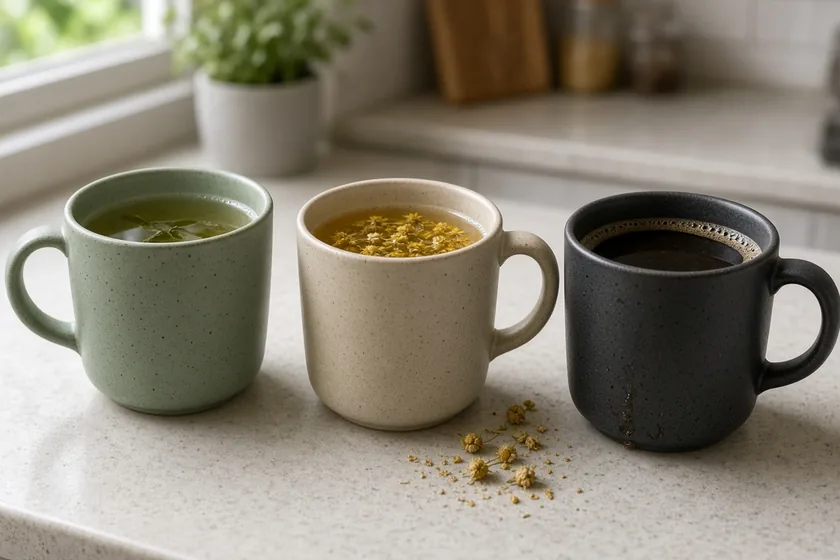
If regular green tea bothers you, a lower-caffeine cup may help.
Fact 3: Decaf Green Tea May Be a Gentler Option
Is decaf green tea better for acid reflux? It may be, if caffeine is your trigger. USDA data for brewed decaffeinated green tea (FDC 171910) list caffeine at about 0 mg per 100 grams. Decaf isn't always zero, though: the FDA notes that decaffeinated coffees and teas still contain some caffeine, so decaf tea may have small amounts. Check the label.
No study we found tested decaf green tea in people with GERD, so this is a practical option, not a proven fix. If decaf also gives you heartburn, the brew strength, an empty stomach, or your add-ins may play a part.
Matcha is made from powdered whole tea leaves, and its caffeine varies by product and serving size, so check the label and start small.
Fact 4: Green Tea Usually Has Less Caffeine Than Coffee, and Some Herbal Teas Have None
Is green tea better than coffee for reflux? For many people, plain green tea may be easier to tolerate than coffee, simply because it usually contains about a third as much caffeine per cup. Cleveland Clinic lists coffee among drinks to limit with GERD "for both acidity and caffeine." No head-to-head trial shows green tea is better for GERD, though. For coffee's wider pros and cons, see our guide to coffee and health.
Which tea is best for acid reflux? There is no single best tea for everyone, but caffeine-free herbal teas are a common starting point. Johns Hopkins Medicine lists herbal tea among watery foods and mentions ginger tea as a possible home remedy for temporary relief. Evidence that herbal teas treat GERD is limited. Here is how common choices compare:
- Chamomile tea: It is caffeine-free, and the NCCIH says it is likely safe in amounts found in teas. That is a safety statement, not proof it relieves reflux.
- Ginger tea: Johns Hopkins calls ginger a useful digestive aid. Want a deeper dive into ginger? Our guide Is Ginger Good for Acid Reflux covers the research, safe amounts, and when ginger can cause heartburn.
- Peppermint tea: Mint is on the NIDDK trigger list, and Johns Hopkins lists peppermint too, so it is often better skipped.
- Black tea: It usually has more caffeine than green tea, and the 2026 Taiwanese study found no lower GERD prevalence in black tea drinkers.
Kombucha is a fermented, often fizzy tea drink, and Johns Hopkins lists carbonated beverages among heartburn triggers. For more, see our guide on whether kombucha helps acid reflux.
Fact Set 3: Timing, Add-Ins, and How to Test Green Tea

How and when you drink it can matter as much as the tea itself.
Fact 5: When and How You Drink Green Tea Matters
When should you drink green tea with acid reflux? No study we found has tested the best time of day for tea, so there is no established rule. A practical approach is to try it with a meal, such as a plain bowl from our oatmeal guide, and to avoid it close to bedtime.
The NIDDK says finishing meals at least 3 hours before you lie down or go to bed may improve nighttime symptoms, and the FDA notes that people vary widely in how sensitive they are to caffeine. A late-evening cup of regular green tea may affect both reflux and sleep.
What you add matters, too:
- Lemon: Citrus is on the NIDDK list of common triggers.
- Mint blends: Many green tea blends include spearmint or peppermint. Read the ingredient list.
- Milk: Johns Hopkins notes that the fat in dairy can aggravate reflux in some people, so nonfat milk may be gentler. Still, the 2019 Taiwanese study found that adding milk to tea or coffee was not independently linked to reflux symptoms.
- Honey or sugar: A small amount may be fine. The same 2019 study found no link between adding sugar and reflux symptoms. Want a deeper dive into honey? Our guide Is Honey Good for Acid Reflux explains what the manuka honey research shows and how much to try.
For a dairy-free tea latte, almond milk is a common choice. Want a deeper dive into almond milk? Our guide Does Almond Milk Help Acid Reflux compares it with cow's milk and other plant milks.
Fact 6: Start With One Cup, and Skip Green Tea Extract Pills
The 2022 ACG clinical guideline conditionally suggests avoiding individual foods that trigger your GERD symptoms, a recommendation based on low-quality evidence. An older evidence review in Archives of Internal Medicine found no published evidence that cutting out specific foods or drinks improved GERD measures, while weight loss and raising the head of the bed did help. A personal test is more useful than a blanket rule.
Try one 8-ounce cup of plain, lightly brewed tea with a meal, and keep a short food diary of the type, strength, add-ins, timing, and symptoms. If one cup sits well, keep it. If even a weak or decaf cup brings on heartburn, a caffeine-free herbal tea may suit you better.
Green tea extract pills are not the same as the drink. The NCCIH reports no safety concerns for green tea as a beverage in adults, but extract supplements can cause nausea and abdominal discomfort, and rare liver injury has been reported, mainly with extract capsules or tablets. Green tea at high doses can also interact with some medicines, such as nadolol, so ask your doctor before using supplements.
When to See a Doctor

Johns Hopkins Medicine advises seeing a doctor if you have heartburn two or more times a week and changes to your diet or eating pattern haven't helped. Mayo Clinic also advises an appointment if symptoms continue despite nonprescription medicines. MedlinePlus notes that GERD can also cause a dry cough, hoarseness, or trouble swallowing.
The NIDDK also advises seeing a doctor for symptoms that could be related to GERD complications or other serious health problems:
- Problems swallowing or pain while swallowing
- Persistent vomiting or loss of appetite
- Blood in the vomit, or vomit that looks like coffee grounds
- Blood in the stool, or stool that looks black and tarry
- Weight loss you cannot explain
Emergency: Call 911 (or your local emergency number) right away if you have chest pain, especially with shortness of breath or pain in your jaw or arm. The American Heart Association notes that heartburn and heart problems can feel alike, so never assume chest pain is just reflux.
Conclusion
So, is green tea good for acid reflux? A plain, modest cup can fit a reflux-friendly routine if you tolerate it, but it isn't a treatment. Research is mixed, and caffeine is one possible trigger. It usually has less caffeine than coffee or black tea; decaf may be gentler, and caffeine-free herbal teas such as chamomile are another option. Skip lemon or mint add-ins if they bother you, avoid late-evening cups, and use a food diary to see what works for you.
For gentle breakfast and snack ideas, see Is Oatmeal Good for Acid Reflux and Are Bananas Good for Acid Reflux. For meal timing and sleep position, see our GERD relief guide.
Does regular, decaf, or herbal tea affect your reflux symptoms differently? Share your experience in the comments.
Related guides:
- Is honey good for acid reflux
- Is ginger good for acid reflux
- Does almond milk help acid reflux
- Does kombucha help acid reflux
- Is bone broth good for acid reflux
Sources
- Eating, Diet, and Nutrition for GER and GERD (NIDDK)
- Symptoms and Causes of GER and GERD (NIDDK)
- Green Tea: Usefulness and Safety (NCCIH)
- Chamomile: Usefulness and Safety (NCCIH)
- Heartburn: Symptoms and Causes (Mayo Clinic)
- Caffeine Content for Coffee, Tea, Soda and More (Mayo Clinic)
- Spilling the Beans: How Much Caffeine Is Too Much? (U.S. FDA)
- GERD Diet: Foods That Help with Acid Reflux (Johns Hopkins Medicine)
- GERD Diet: Foods To Eat and Avoid (Cleveland Clinic)
- ACG Clinical Guideline for the Diagnosis and Management of Gastroesophageal Reflux Disease (American Journal of Gastroenterology, 2022)
- Kaltenbach et al., Lifestyle Measures in GERD (Arch Intern Med, 2006)
- Kuo et al., Tea Consumption and GERD Prevalence (Int J Med Sci, 2026)
- Chen et al., Beverage-Related Risk Factors of GERD (Neurogastroenterol Motil, 2022)
- Chang et al., Alcohol, Tea, and Erosive Esophagitis (PLOS ONE, 2017)
- Wei et al., Tea and Coffee in GERD (Tzu Chi Med J, 2019)
- Chen et al., Green Tea and Gastrointestinal Disorders (Front Nutr, 2024)
- Sun et al., Tea and Digestive Diseases (Clin Nutr ESPEN, 2024)
- USDA FoodData Central nutrient records used in this article: green tea, brewed, regular 171917, green tea, brewed, decaffeinated 171910, chamomile tea, brewed 174156
- Gastroesophageal Reflux Disease (MedlinePlus)
- Heartburn or Heart Attack? (American Heart Association)
FAQ
1. Is green tea good for acid reflux?
It can be, in a modest amount, if you tolerate it, but it isn't a treatment. Caffeine can still trigger heartburn, so start with one weak or decaf cup with a meal.
2. Does green tea cause acid reflux?
It can for some people. Caffeine, which the NIDDK lists among common GERD triggers, is one possible contributor, though sensitivity varies. Studies on tea and reflux are mixed.
3. Is decaf green tea better for acid reflux?
It may be, if caffeine is your trigger. USDA data list brewed decaf green tea at about 0 mg of caffeine per 100 grams, though decaf products can still contain small amounts.
4. Is green tea better than coffee for reflux?
For many people, it may be easier to tolerate because an 8-ounce cup of green tea has about 29 mg of caffeine, compared with about 96 mg in brewed coffee, according to Mayo Clinic. No head-to-head trial shows green tea is better for GERD.
5. Which tea is best for acid reflux?
There's no single best tea for everyone. Caffeine-free herbal teas, such as chamomile or ginger, are a common starting point. Peppermint tea is often better avoided.
About the author

Health Researcher and Writer
Haider Nadeem is a health researcher and the writer behind Healthy Eats Guide. He writes about health problems he faces or sees people around him face, and turns careful research into practical guides. Articles are researched and drafted with AI assistance, then fact-checked and edited by Haider using cited sources such as USDA, NIH, and peer-reviewed research.
Related blogs
Is Popcorn Good for Acid Reflux: 6 Evidence-Based Facts
Is popcorn good for acid reflux? Learn whether air-popped, buttered, and microwave popcorn may affect GERD symptoms, plus tips on portions, toppings, and timing.
12 min read

GERD Relief: 7 Proven Tips to Manage Flare-Ups
GERD relief that works: 7 proven tips covering meal timing, trigger foods, weight, sleep position, medicines and surgery, plus warning signs to act on.
9 min read
Is Oatmeal Good for Acid Reflux: 7 Evidence-Based Tips
Is oatmeal good for acid reflux? See why a plain bowl often sits well, how instant and overnight oats compare, and which toppings are less likely to trigger heartburn.
12 min read
Newsletter
Get practical nutrition guides in your inbox
Clear food-by-food advice and diet tips for everyday eating — no spam, unsubscribe anytime.