
Arthritis in Fingers: 7 Signs, Causes and Relief Options
Arthritis in fingers: learn the 7 common signs, how osteoarthritis differs from inflammatory types, and which treatments the 2026 ACR guideline recommends for hand OA.
Medical disclaimer: This article is for general information only and is not medical advice. Joint pain in the hands has many possible causes. See a doctor for a diagnosis, and check with a pharmacist or doctor before starting any medicine or supplement.
Introduction

Arthritis in the fingers means inflammation or damage in one or more of the small joints of the hand. The most common type is osteoarthritis (OA), where the cartilage that covers the ends of the bones gradually breaks down. Other types, such as rheumatoid arthritis, psoriatic arthritis, gout and lupus, work differently and need different treatment (Cleveland Clinic). This guide covers the common signs, the main types, what raises your risk, how doctors diagnose it, and the treatments current guidelines support.
Which finger joints are involved
Each finger has three joints and the thumb has two, plus a joint at its base:
- DIP (distal interphalangeal) joints: the joints nearest the fingertips.
- PIP (proximal interphalangeal) joints: the middle knuckles of the fingers.
- MCP (metacarpophalangeal) joints: the large knuckles where the fingers meet the hand.
- Thumb CMC (carpometacarpal) joint: the joint at the base of the thumb, near the wrist.
Hand OA most often affects the DIP joints and the thumb base, then the MCP and PIP joints (Deutsches Ärzteblatt review). Rheumatoid arthritis more typically affects the MCP and PIP joints, often on both hands.
7 common signs of arthritis in fingers
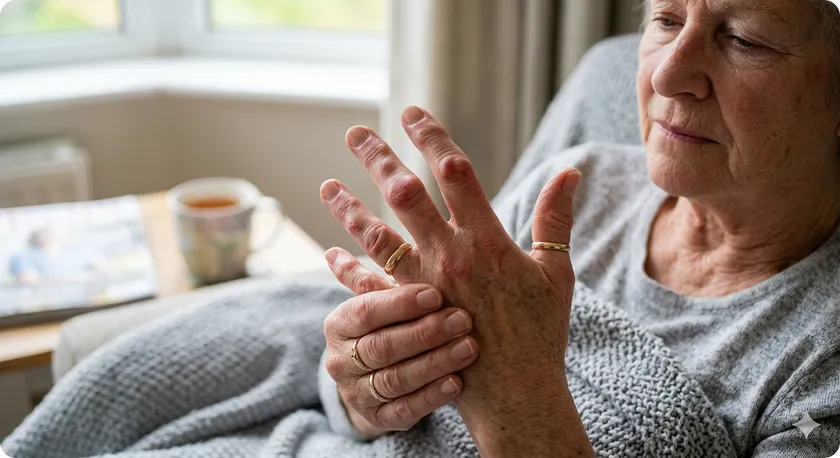
These signs are common, but none of them alone confirms arthritis (Cleveland Clinic):
- Joint pain. This may be a dull, constant ache or a sharper pain with movement. OA pain tends to be worse with use or later in the day.
- Stiffness. Inflammatory arthritis, such as RA, usually causes longer morning stiffness that eases as you move. OA stiffness is usually brief.
- Swelling and warmth. A joint may look puffy or feel warm. A sudden hot, red, swollen joint, especially with fever, needs urgent care (see below).
- Grinding, clicking or popping (crepitus). Joint noises are common and harmless when there's no pain or swelling, so they aren't specific to arthritis. Noise together with pain or swelling is worth getting checked (Arthritis Foundation).
- Reduced grip and motion. Buttoning, opening jars or pinching small objects can become harder.
- Bony bumps (nodes). Heberden's nodes at the DIP joints and Bouchard's nodes at the PIP joints are associated with hand OA (NHS Lothian RefHelp). They are common and support the picture, but a doctor still makes the diagnosis from the full assessment.
- Pain at the base of the thumb. Thumb CMC arthritis can make pinching and gripping painful.
Not all finger pain is arthritis. Tendonitis, trigger finger and other soft-tissue problems can cause similar pain (Cleveland Clinic).
Types of arthritis that affect the fingers
| Type | What happens | Typical hand pattern |
|---|---|---|
| Osteoarthritis | Cartilage breaks down gradually, with bony changes | DIP, PIP and thumb base; nodes common |
| Rheumatoid arthritis (RA) | The immune system attacks the joint lining (synovium) | MCP and PIP joints, usually both hands; prolonged morning stiffness |
| Psoriatic arthritis | Inflammatory arthritis linked to psoriasis | Can affect DIP joints or a whole swollen finger |
| Gout | Uric acid crystals trigger sudden, very painful attacks | Often one hot, red, swollen joint |
| Lupus arthritis | Joint inflammation as part of lupus, an autoimmune disease affecting many organs | Usually milder than RA, may move between joints, and rarely erodes bone (HSS) |
| Post-traumatic arthritis | OA that develops in a joint after an injury such as a fracture or dislocation | The previously injured joint |
Cartilage "wear" describes OA, not the other types. RA, psoriatic arthritis and lupus are driven by inflammation from the immune system, and gout by crystals. Lupus and RA are different diseases, even though both can affect the small hand joints. Learn more in our guide to the signs of lupus.
Risk factors
OA isn't simply the result of lifelong hand use. Recognised risk factors for hand OA include (Cleveland Clinic; Deutsches Ärzteblatt review):
- older age, with a marked rise from about 50
- female sex and menopause
- family history (genetics)
- overweight or obesity
- joint laxity (loose joints)
- a previous joint injury, or occupational exposure such as heavy, repeated hand use
- smoking, and having an autoimmune disease (for arthritis in general)
Post-traumatic OA follows a specific injury. That's not the same as repetitive motion, which is a separate and weaker risk factor.

How finger arthritis is diagnosed
A doctor will usually:
- Take a history: which joints hurt, how long morning stiffness lasts, any injuries, psoriasis, family history or other symptoms.
- Examine your hands: looking for swelling, nodes, warmth, deformity and grip strength.
- Order X-rays: to look for joint space narrowing, bone spurs or erosions.
- Order blood tests when needed: for example, inflammatory markers, rheumatoid factor or anti-CCP antibodies if inflammatory arthritis is suspected, or uric acid for gout. Fluid may be drawn from a joint if infection or gout is possible.
Getting the type right matters, because treatment differs a lot between OA and inflammatory arthritis (Cleveland Clinic).
Treatment for hand osteoarthritis
In September 2026 the American College of Rheumatology (ACR) released updated OA recommendations for the knee, hip and hand, replacing the 2019 ACR/Arthritis Foundation guideline (ACR press release, 14 Sept 2026). Its key points for hand OA (ACR 2026 guideline summary):
- Strongly recommended: self-management, exercise, topical NSAIDs and oral NSAIDs (when clinically appropriate). Topical NSAIDs are conditionally preferred over oral NSAIDs.
- Conditionally recommended: hand orthoses (splints) for thumb-base and finger OA, arthritis gloves, local heat or cold, paraffin wax baths, cognitive behavioural therapy, acupuncture, acetaminophen (paracetamol), duloxetine, steroid injections into the joint, and methotrexate for erosive hand OA.
- Strongly recommended against: glucosamine, chondroitin and glucosamine–chondroitin combinations, as well as hydroxychloroquine, bisphosphonates and TNF inhibitors for OA.
This changes the advice on chondroitin. The 2019 ACR/AF guideline had conditionally recommended chondroitin for hand OA, based on a single trial (2019 ACR/AF guideline). The 2026 update now recommends against it.
Hand therapy, splints and daily tools
A hand or occupational therapist can teach joint-protection techniques, gentle range-of-motion and strengthening exercises, and how to use a splint. Splints for the thumb base are often worn at night or during specific tasks. Examples of gentle exercises include making a loose fist, bending each finger in turn, and touching your thumb to each fingertip. Stop if an exercise causes sharp pain. Adaptive tools such as jar openers, button hooks and thick-handled utensils reduce strain.
Pain relievers: NSAIDs vs acetaminophen
NSAIDs such as ibuprofen and naproxen relieve pain and reduce inflammation. Acetaminophen (paracetamol) relieves pain but doesn't treat inflammation or swelling (NHS), and its benefit in OA is small (2019 ACR/AF guideline). For hand OA, a topical NSAID gel is often tried first because less of the drug reaches the rest of the body.
NSAID precautions: oral NSAIDs may not be suitable if you have kidney, heart or liver disease, a current or past stomach ulcer, high blood pressure or a past stroke, or if you're pregnant or trying to get pregnant (NHS). They can also interact with other medicines, such as blood thinners and other NSAIDs. Use the lowest dose for the shortest time, and ask a pharmacist or doctor before long-term use.
Diet and weight
No food or diet cures hand OA (Cleveland Clinic). A balanced, Mediterranean-style diet rich in vegetables, fruit, fish, beans and wholegrains is good for overall health and may help you manage weight (Arthritis Foundation). Not smoking is also worthwhile.
Treatment for inflammatory arthritis
RA, psoriatic arthritis and lupus usually need a rheumatologist (a doctor who specialises in arthritis and autoimmune disease). RA is treated with disease-modifying antirheumatic drugs (DMARDs), such as methotrexate, which slow the disease and help prevent joint damage. Painkillers and NSAIDs only ease symptoms (NHS). Gout has its own acute treatments and urate-lowering medicines. That's why an accurate diagnosis comes first.
When to get medical help

Urgent: same day (urgent GP, NHS 111, urgent care or A&E): a joint that suddenly becomes very painful, hot, red or swollen, especially if you have a fever or feel unwell, or if you can't move the joint. This can be septic arthritis (a joint infection) or gout, and infection can damage the joint quickly without treatment (NHS).
Routine: book an appointment if you have:
- ongoing pain, swelling or stiffness in your finger joints
- morning stiffness lasting more than about 30 minutes, or swelling in several joints on both hands
- worsening stiffness, more frequent flares, or growing difficulty with daily tasks
- joint changes or deformities, a new skin rash, or psoriasis along with joint pain
FAQ
1. What does arthritis in the fingers feel like?
It often feels like a dull ache or stiffness in one or more finger joints, sometimes with sharp pain when you move them. OA pain tends to worsen with use, while inflammatory arthritis usually causes longer morning stiffness.
2. Why does it hurt when I bend my finger?
In OA, damaged cartilage and bony changes in the joint can make bending painful. Tendon problems such as trigger finger or tendonitis can also cause pain when bending, so a doctor's exam helps find the cause.
3. What is the hard bump on my finger joint?
Hard, bony bumps at the fingertip joints (Heberden's nodes) or middle knuckles (Bouchard's nodes) are associated with hand osteoarthritis. A doctor can confirm the cause with an exam and, if needed, an X-ray.
4. Is finger twitching a sign of arthritis?
Finger twitching isn't a typical symptom of arthritis. See a doctor if twitching is persistent or comes with numbness, weakness or other new symptoms.
5. Do glucosamine or chondroitin help hand arthritis?
The 2026 ACR guideline strongly recommends against glucosamine, chondroitin and combination products for hand, knee and hip osteoarthritis. Talk to your doctor about options with better evidence, such as exercise, splints and topical NSAIDs.
6. Can arthritis in the fingers be reversed?
Most types can't be cured, but treatment can ease pain and help preserve hand function. In inflammatory arthritis such as RA, early treatment with DMARDs can help limit joint damage.
Conclusion
Arthritis in the fingers covers several conditions. OA is the most common, but RA, psoriatic arthritis, gout and lupus need different care. Pain, stiffness, swelling, nodes and thumb-base pain are common signs, and a doctor can confirm the type with a history, an exam, X-rays and blood tests when needed. For hand OA, current ACR guidance favours self-management, exercise, splints and NSAIDs (topical first), and advises against glucosamine and chondroitin. Get urgent care for a suddenly hot, red, swollen joint.
External Links
About the author

Health Researcher and Writer
Haider Nadeem is a health researcher and the writer behind Healthy Eats Guide. He writes about health problems he faces or sees people around him face, and turns careful research into practical guides. Articles are researched and drafted with AI assistance, then fact-checked and edited by Haider using cited sources such as USDA, NIH, and peer-reviewed research.
Related blogs

Best Diet for Arthritis: 7 Essential Foods for Joint Health
The best diet for arthritis: 7 joint-friendly foods, what to limit, how weight and inflammation affect joints, a sample meal plan and when to see a doctor.
9 min read

Anti-Inflammatory Snacks: 10 Proven Fruits for Inflammation
Anti-inflammatory snacks made simple: 10 fruits for inflammation, easy protein and healthy-fat pairings, low-inflammatory breakfast ideas and when to see a doctor.
14 min read

Top 10 Anti-Inflammatory Foods to Eat in 2025
Discover the top 10 anti-inflammatory foods to eat in 2025 to fight chronic inflammation, boost immunity, and support overall health naturally.
7 min read
Newsletter
Get practical nutrition guides in your inbox
Clear food-by-food advice and diet tips for everyday eating — no spam, unsubscribe anytime.